
Substantially Reducing My Plastic Waste.
Fighting Pollution at the Source and Doing a Good Thing.

When I was in Montreal recently, I chatted to a friend about an article I wrote a while back about how crappy I thought the Canadian Conservative party’s war on reducing plastic waste was. My friend seemed to think it was a little

hyperbolic, but I do really think this is super important: not only is most of the plastic we get from the super polluting petrochemical industry, we are continually learning lots of ways in which the waste from plastic creates problems.
Politics Wrapped in Plastic.

Cinq Personnes is a blog about living a better life, doing the right thing, and creating a better world for everyone. Consider subscribing to support my work.
Now, to be perfectly clear, modern society needs plastics. They are durable (a double-edged sword), easy to clean, easy to make and form, and lightweight. In many applications, like say in vehicles of all kinds, plastics help significantly reduce weight and improve durability, which reduces waste. They also are used for all kinds of other important things in society.
But, what I tried to get across, perhaps unsuccessfully in my earlier blog post (you can be the judge of that above) is that we are using way more than we need. We don’t need to package everything in tons of hard-to-recycle plastics manufactured to be used once (yes, sometimes this packaging can reduce waste, but as I hope I’ll make clear in this post we do go way to far).
My friend brought up how plastic straw bans had the effect of turning people off of environmental action — which is a good retort to my “stop whining about straws” — some people really want their straws and inertia is strong.
I think the solution here is that there needed to be a greater effort to make sure the alternatives were good, and that the good alternatives were made available. A lot of paper straws I’ve used recently are literally fine if you drink your drink at a regular pace, but I certainly did experience some earlier in the plastic straw ban that broke apart and got soggy (the market forces seem to be working!). We should have also made sure people were aware of the other options, like straws made of literal reed that are not going to get mushy, reusable straws, and also just reminding people that not using a straw has a big positive impact!
While I did sort of argue for the leverage of policy in that post, you just can have a much bigger impact when you change the rules of the game than when you hope people will just do the right thing on their own volition. I get how that can sound a little authoritarian, but at some level we have states to protect us from the tragedy of the commons. However, it doesn’t have to be an either or: while I support policies to reduce single-use plastic use (and plastic use in general where we have decent alternatives), I think it also makes sense to try to take some personal responsibility to reduce our own impact for maximum effect, and hey — we don’t know how bad some of this microplastics stuff might turn out to be, so it seems sensible to deploy the precautionary principle. So for the past several months, I’ve tried really hard to create less plastic waste, and this post is kind of about my learnings on that, what I did, and roughly what the impact looks like.
To some extent, the problem of microplastics can be dealt with in several ways. We want to reduce plastic production at the top of the funnel, improve waste collection and recycling in the middle, try to reduce what ends up in the environment, clear plastic waste out of the environment (which one of the organizations I’m donating to as per last week’s post does!).
To Give.
·Gift giving can be a lot of fun, and it’s something I think about a fair amount, especially during the holiday season. But to be frank charitable giving is not something I have thought much of.
And then at the sort of the bottom of the funnel, we might want less of the stuff in and around our bodies to be shedding plastic particles.
This frankly does cause me anxiety, and is kind of perfectly set up to, because everyone is very uncertain about the impacts of microplastics on our health. The good news is that the human body is accustomed to having to remove foreign material, even if the type of material has varied over the ages. While it’s certainly plausible that all of this plastic is going to create some real problems in the future, for the most part now we don’t have a lot of specific health trends that seem to be driven by it (unless someone reading this is better informed than me on this topic, in which case please leave a comment!). At the same time, I think one of the best possible responses to uncertainty is taking concrete actions that we know at the very least should mitigate the risks we are uncertain about.

At the top of the time period, I was not exactly starting from zero. A lot of the stuff in my kitchen is glass, or metal, or wood, and so that stuff when it someday breaks and ends up in the waste stream will not contribute to plastic pollution. A lot of people are probably in a similar boat, but some people use disposable plastic cutlery and cups and lots of tupperware, and might want to use better alternatives!
At the same time, some years ago a great video by Paige Saunders kind of convinced me to stop buying Ikea furniture made of, or otherwise wrapped in plastic.
And since I was already on the “Buy-it-for-Life” train, I sort of was already selecting a lot more stuff that was made of materials which are either super durable, or repairable, and that often takes you away from the direction of plastics.
Spend on the Everyday.

Welcome back to Cinq Personnes, for what I hope will be a post that lets me influence you into changing how you spend.
So, there are some things I had sort of already gotten out of my life, but if I’m honest, removing plastic cookware and furniture and whatnot is probably mostly just removing some small amount of plastic particulate from your home; while this stuff will become plastic waste at some point, it is often fairly durable (not a bad thing!), and I hope you’re not regularly putting furniture in the trash.
So really reducing the plastic waste I produced meant looking elsewhere, and this is where I realized that the low- and zero-waste folks had paved the way quite nicely, often with online resources. There are just a lot of ways you can reduce your waste — though ironically some of the most interesting, like community-based “refilleries” where you can go get yogurt and other stuff like that in bulk from a store in a reusable container, aren’t really available where I live — I’m sure that will change at some point, and so I was sort of forced to do what I actually could.
So what could I do?
Well to start, getting way more aggressive about properly recycling. Lots of stuff still can’t be easily recycled, like a lot of plastic bags and wraps, but lots of stuff can be that people don’t pay enough attention to, like toothpaste tubes, small paper packaging and cardboard, almost any hard plastic food container, and the like. Recycling isn’t ideal because you’re still producing waste and having to go to the trouble to ship it around and reprocess it, but it isn’t getting buried in the earth and virgin material isn’t being produced so it is something.
I also went down a deep rabbit hole learning about EPR or Extended Producer Responsibility, a system of recycling funded by and sometimes run by the same major companies that produce the plastic packaging waste. Which the jury seems out on, but which in theory might make them think in a more circular way and consider using stuff they can repurpose more easily.
I wasn’t some fiend who threw all my paper in the trash or whatever, but this probably did have some impact!
Next was actually using less plastic and eliminating it where I could, and here there were two major focuses — food and personal care. These are places where you are probably using a lot of physical stuff, but also where plastic is everywhere — because it’s a good way of packaging things that could leak or go bad. Ironically, it’s also where plastic is going to come into contact with you and the stuff you eat.
On the food side, the big thing I did was try to buy in greater bulk. The benefit here is just that larger packages are a bit more weight-efficient with their packaging use, but this is limited in its effectiveness. Companies pay to ship their goods and have an incentive not to ship loads of extra packaging around the actual product. I thought my individual daily yogurt cups were probably super wasteful, but switching to the large cylindrical tubs only reduced waste by a couple of grams every week — not nothing, but not a lot.
The solution to this to some extent is to try to find foods that don’t need to be packaged this way. Dry goods are often available in bulk, which is going to do a lot more to reduce plastic waste, and fresh fruit and vegetables are also quite widely available without plastic (and with of course).
Ultimately though, cutting this stuff back is hard. You have to eat, and many things just aren’t really available without plastic packaging, or require huge efforts to find. It might be worth pursuing this if you’ve done other easier things, but this is not the easiest.
What is the easiest thing? Personal care and cleaning stuff.
As it turns out, the stuff we use to clean our homes and bodies use a lot of plastic, and there are also pretty good and widely-available options that use far less. For example, I used to use one of those Swiffer Wetjet mops that is super good and easy, but which produces a surprising volume of waste in the form of bottles of cleaner and pads. Switching to a still partially plastic but reusable mop from Vileda that still satisfyingly sprays cleaner out for you to scrub, and also has machine-washable fabric pads, as well as a reusable duster will reduce my plastic waste this year by over a kilo!
Even bigger is all the stuff you use in the bathroom. Now, while I thought it was cool and fun to switch to a safety razor (Henson) and a toothbrush (Nada)
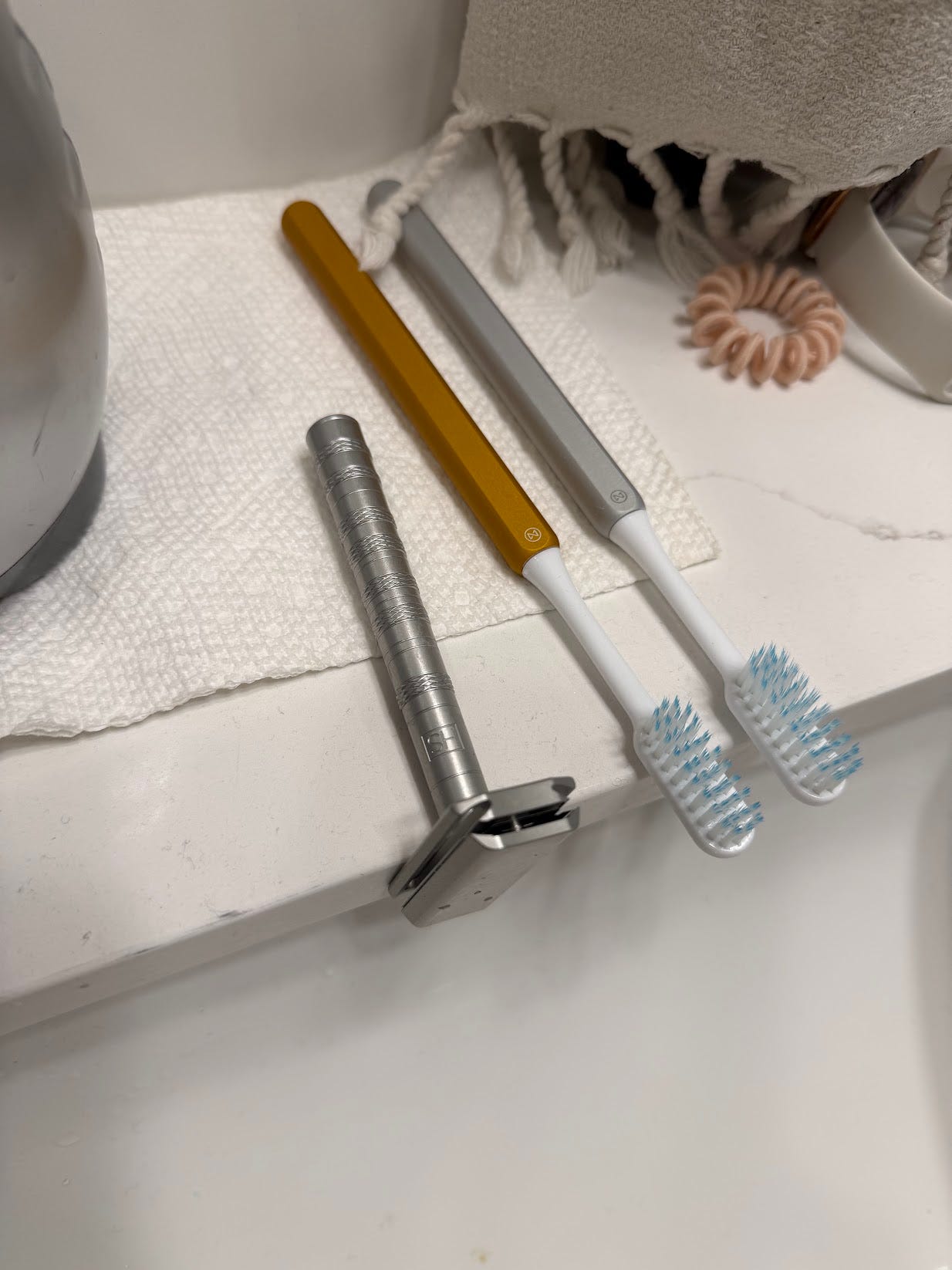
with a reusable handle and small plastic heads you switch out and are shipped back to be recycled by the manufacturer, these things just don’t have that big of an impact because they don’t weight a lot, and you don’t actually switch razor cartridges or toothbrushes that often. These products are still worth switching to because they are just as good as the plastic-heavy alternatives (I thought about a bamboo toothbrush, but couldn’t find one I liked) and will reduce waste over time (they are also both made in Canada which I personally like), but they aren’t going to have massive impacts.
What does have a massive impact are things like hand soap, shampoo, body wash, conditioner, and cleanser. I shower a lot because I sweat a lot, and I end up going through a bottle of each of these usually once every month or two. As it turns out though, you can just use bars for all of these things, and as far as I can tell it’s just as good, and maybe less likely to be wasted. Now, the cleanser bar I got (Cetaphil) was wrapped in a thin plastic wrapper, but compared to the plastic bottles I used to get, this still saves like a kilo a year of plastic. All the other products are fairly similar. Another Canadian company
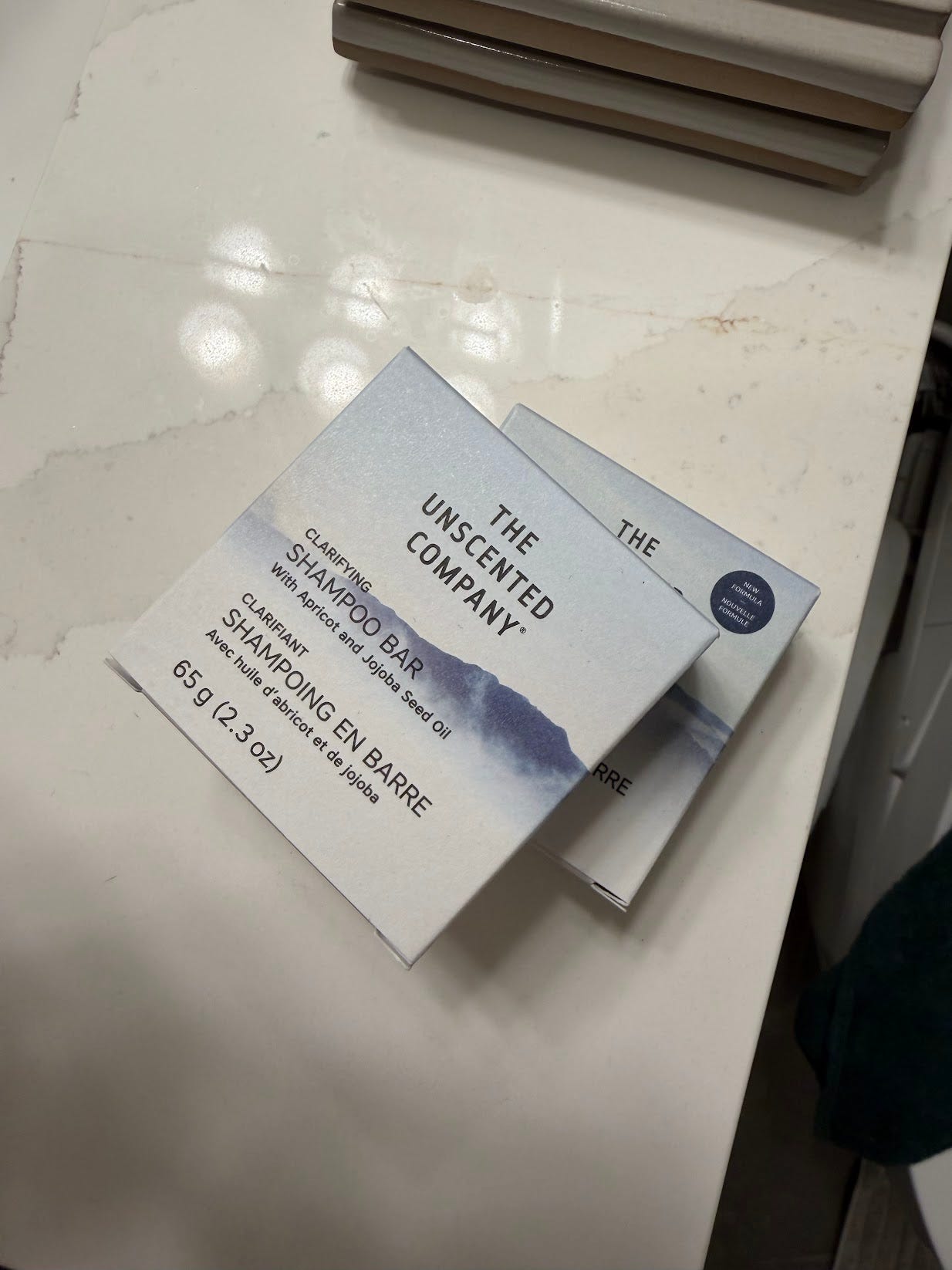
called “The Unscented Company” makes a wide range of bars — everything that come packaged only in cardboard and are great and unscented, as well as bulk liquid soaps if you want those.
I’m mentioning specific products for people who might live in places where they are available. But I imagine most people will have local options for some of these things, and if you don’t well you work with what you have!
There are also all kinds of other similar products and easy swaps in similar situations to this. You can get silk tooth floss, deodorant wrapped in cardboard, laundry detergent tabs that look like gum sticks and come in paper or cardboard and the like. You can also get reusable beeswax wraps to replace saran wrap and reusable silicone (still plastic-ish but less likely to be thrown out after one use) pouches to replace ziplocs. The point is, there are a ton of products where you can just buy the one that isn’t wrapped in, or made of plastic, and it works basically just as well.
One area where we all have significant leverage to reduce our plastic consumption is actually in our clothing. I don’t remember the particular creator and I really tried to avoid any kind of vertical video because of how addictive it is, but I remember seeing a video from a creator talking about how much our clothing is made out of plastic in the form of polyester, or nylon, or one of the many other plastic materials spun into fibres in clothes. Now, obviously clothing is somewhere between furniture and something like packaging in terms of how regularly you get rid of it. But I think most people probably buy some new clothing every year and simply choosing pieces which have a low or nonexistent plastic content can have a big impact when you eventually dispose of that clothing at the end of its life. And the thing is, almost more than than any other category it’s possible to choose products that have basically no plastic; in fact, entire brands like Kotn have made organic materials their bread and butter.
It is remarkable how many Canadian companies make great and innovative products for living more sustainably. Maybe we could subsidize fewer car factories and promote these businesses instead.
A New Industrial Policy for the Greater Good, Today.
·This is going to be a very unusual post from me. Cinq Personnes is generally centred around self-improvement and ideas for living better, but today’s post is instead about policy ideas for a better country — it took me a long time to write.

Something which I think people are becoming increasingly aware of though is that much of the waste from your clothing isn’t produced when you dispose of it. Instead, as anyone who has cleared a lint trap knows, clothing sheds fibres all the time, and particularly when you do things like wash it vigourously. This is why it’s kind of crazy that while we filter the air coming out of a dryer we don’t generally filter the water coming out of a washing machine, and as a result of washing machines dump a huge amount of tiny plastic particles and fibres into waterways. Now, the ideal solution to this like is starting to be implemented in some European countries is mandatory filters on the outlets of washing machines. But in the meantime, a product like the Guppyfriend is basically a garment bag made out of filter material, that you can put things like technical wear in, so that when they inevitably shed fibres in the wash, you can just collect them and dispose of them properly.
So then, I guess the question is: what is the actual impact?
Well, based on some cursory research, the average Canadian produces about 130 kg of plastic waste a year. I live what is probably a slightly more environmentally friendly than average lifestyle (if we’re being conservative) so I probably create a bit less than that. Based on some calculations I’ve made looking at the difference in waste between products and places where I can eliminate products, I can account for at least 10 kg of reduced waste, and frankly, I think that number could get quite a bit larger, depending on how you factor in longer-term things like clothing. That is to say, I think it’s reasonable to suggest that I’ve probably reduced my plastic waste by at least 10% and possibly as high as 30% overtime as some of the longer lifespan items I have get replaced. Obviously that’s not elimination, and I’m sure there’s someone online who will say ~20% is nothing, but over the next 50 years I should be able to eliminate a tonne of plastic waste by myself, and by doing stuff that did require some intention but wasn’t actually difficult. It’s totally believable to me that as a nation we could eliminate tens of millions of tons of waste every year today just by adjusting our habits slightly, and without really any major inconvenience.
The natural question then is: what’s actually remaining?
Well, a lot of it is packaging you can’t get away from easily, which is why the society-level stuff matters and clearly has an impact. The alternatives require effort to come up with test and scale, and so without a reason to do it — a financial reason, they probably won’t. More easily recyclable stuff is coming because of rules in Canada and Ontario around recycling and packaging, but also things like packaging for dried foods that mostly uses cardboard and only really used plastic for a seal to keep food fresh — still using plastic for the value it adds, but as little as possible. This stuff probably wouldn’t be happening and certainly not at the same pace if there wasn’t legislative incentives to do so.
Plastic also just is in a lot of stuff where it does make sense — vehicles that benefit from being lighter, things like paints where it adds durability, medical supplies where it makes cleaning easier — we often do use it for good reason. And while we can try to work around the margins, this stuff is less of a huge issue if we have good recycling and waste management and high-quality materials, and we keep looking into things like microplastics and trying to reduce shedding and improve things like air quality; as it turns out, a lot of dust, indoors and outdoors, appears to be from plastic, be it from things like our clothing or from things like tires breaking down. So I don’t think we should stop using plastic, but we should try to create better plastics that have less negative impacts (which we are clearly doing), while also improving waste management, continuing to do research into health, and probably thinking about how we can treat plastic a bit more like asbestos — using it in applications where it doesn’t actively get broken down.
Electronics are a fairly big user as well and you don’t get rid of devices often, and sometimes it is just good for convenience. The monitor I am looking at is wrapped in a plastic shell, and that’s fine, but Apple makes monitors wrapped in aluminum that surely have substantially less plastic by mass overall and are really nice; this is more expensive, but that might be less of an issue if we made stuff more repairable which I talked about before.
Five Common Sense Tech Regulations That Would Make Our Lives Better.

Something that I have strong feelings about is that tech is under-regulated, or perhaps improperly regulated.
The point of this post is not to whine about this stuff, it’s to point out that while seeking larger policy interventions, there are a lot of things concerned individuals can do — most of them really easy, and I’d say a 10-30% reduction in waste is a big deal! The best way to tackle huge problems is to tackle them from multiple directions simultaneously
Have you heard of the concept of Cradle-To-Cradle design? There is a 2002 book of the same name, which discusses our challenges of waste and the limitations of the classic 3 R's, and outlines an alternative system of material cycles to eliminate rather than just reduce human consumption and destruction of finite resources.
I found it to be a thought provoking read nearly 20 years ago now, both for the environmental science and design portions of my brain.
https://en.wikipedia.org/wiki/Cradle-to-cradle_design
I took a look, it is actually available as an audiobook through TPL on Libby.
One strategy you didn't explicitly mention was shopping at literal bulk stores. Bulk Barn lets you bring your own reusable containers (and gives you a discount if you do so on certain days), or you can re-use bulk bags as a shuttle between the store and your home containers.